
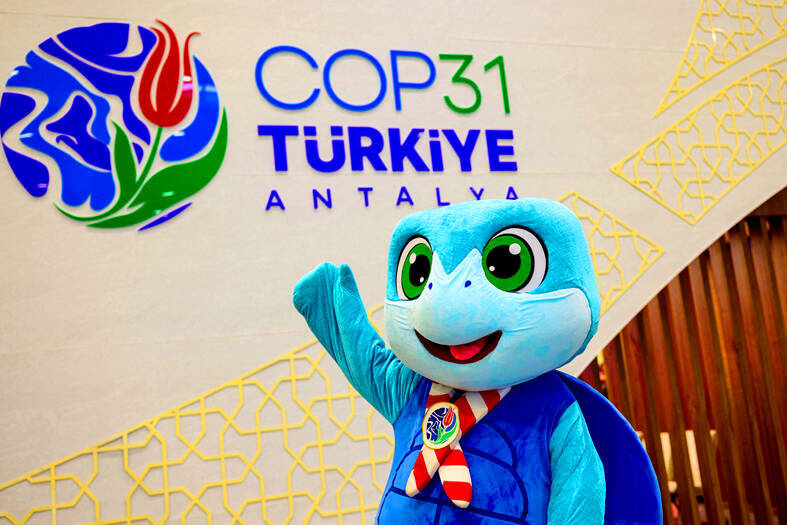
2050 GOALS: The nation aims to raise its circular material input rate to 2.5 times the 2020 level, double research productivity and lower material consumption by 35%
By Esme Yeh / Staff reporter
Taiwan will cooperate with international partners on the circular economy, in line with the COP31 summit’s focus on the circular economy and zero waste, Minister of Environment Peng Chi-ming (彭?明) said yesterday.
The COP31 talks ended in Turkey on Friday.
Zero waste and circular economy were advocated at the COP31, with a call for joint action to turn circular economy effects into “tangible climate benefits,” Peng said.
Taiwan has limited natural resources and depends on imports for up to 76.14 percent of its raw materials, he said.
Given that the nation — with its semiconductor, electronics and high-tech manufacturing sectors — plays a key role in the global supply chain, it must improve resource efficiency and turn waste resources into circular materials to reduce material dependency amid supply chain risks and demand for green materials, he added.
“Climate action should not focus solely on the energy transition,” Peng said. “We must also address product design, material use and industrial production models to reduce resource consumption and carbon emissions.”
COP31 put two initiatives on the table: reduce projected global waste growth by half and boost circular material use rate in manufacturing to at least 15 percent.
That showed that global climate action is shifting beyond an energy transition to including systemic changes in resource use, product design and industrial production models, the Resource Circulation Administration said.
Taiwan’s economic growth is decoupling from waste generation, the agency said, adding that Taiwan’s economic growth reached 8.76 percent last year, while non-business waste generation dropped by 0.22 percent, with a recycling rate of up to 60.23 percent.
That marked the first annual decline in waste generation in nearly a decade, and is an early positive indication of decoupling between economic growth and waste generation, it said.
Taiwan has established a circular economy roadmap and aims to reach three goals by 2050: doubling resource productivity, lowering domestic material consumption per capita by 35 percent and raising the circular material input rate to 2.5 times its 2020 level, the agency said.
In related developments, the Ministry of Foreign Affairs yesterday expressed Taiwan’s gratitude to allies for speaking up for the nation at COP31.
During high-level meetings on Tuesday and Wednesday, four of Taiwan’s diplomatic allies — Guatemala, Belize, Saint Vincent and the Grenadines, and Paraguay — through speeches and written statements voiced support for Taiwan’s participation in global climate efforts, it said.
As a responsible member of the international community, Taiwan has long played an active role in global climate action, building extensive experience and achieving tangible results in carbon reduction, climate adaptation, clean technology and sustainable development, the foreign ministry said, adding that Taiwan has the capacity and willingness to make further contributions to global climate governance.
Given the shared global challenge of climate change, no capable contributor should be excluded from international efforts for political reasons, it said, calling on the international community to support Taiwan’s meaningful participation in mechanisms under the UN Framework Convention on Climate Change and the Paris Agreement to contribute to global climate governance and a sustainable future.
Additional reporting by CNA
新聞來源:
TAIPEI TIMES