
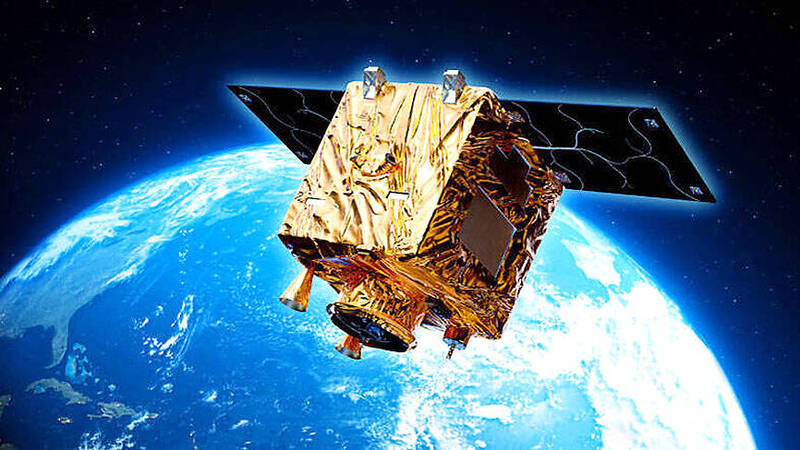
EARLY WARNING:Detecting the earliest signs of a kinetic attack is only possible if there are space situational awareness capabilities in place, expert Jason Wentz said
By Fang Wei-li and Fion Khan / Staff reporter, with staff writer
Intelligence, surveillance and reconnaissance (ISR), communications resilience and space domain awareness are the capabilities Taiwan needs the most, US space companies said.
The American Institute in Taiwan (AIT) from Sunday last week to Wednesday hosted “Space Industry Day,” bringing together the Taiwan Space Agency, the Ministry of National Defense’s Joint Logistics Command and US space companies for closed-door discussions.
US industry representatives also met with the media after the event.
Space-based ISR enables users to see farther than ground-based or airborne platforms can, said Gregory Pipes, Asia-Pacific customer lead at HawkEye 360, which uses satellites to gather intelligence on ground-level activities.
“To properly understand potential threats to Taiwan, you need to be able to see clearly to the north, south, east and west,” he said, underscoring the importance of the technologies.
The company has launched 16 clusters of three satellites each to collect radio-frequency data, helping defense partners detect, geolocate and identify radio signals, Pipes said.
This provides early warning of threats, a better understanding of radar, communications or GPS jamming signals, and could also cue other collection platforms such as optical or synthetic aperture radar satellites, he said.
Asked whether the technologies had been tested in real-world combat or “gray zone” scenarios, Pipes discussed three capabilities.
The first is GPS jamming detection, which is highly relevant in civilian and wartime situations, he said, adding that GPS jamming could be detected from space.
The second is electronic warfare, including detecting counter-drone and air defense radar signals, he said.
The third is geolocating threat emitters to give military personnel the data needed to neutralize threats, he said, adding that the technology was applicable to “gray zone” operations and conventional warfare.
Taiwan faces unique and potentially more complex challenges than other countries do, said Travis Langster, a former US defense official, and founder and CEO of Tora Consulting.
The company is helping Taiwan understand how space capabilities can enhance national resilience, he said.
Taiwan’s adversaries could exploit undersea cables to create various challenges, cutting off the nation’s primary means of communication and key channels for monitoring its surrounding environment, Langster said.
Undersea cables are often raised as a concern in Taiwan’s communications sector, which has prompted discussion of beyond-5G satellite communications, Slingshot Aerospace account manager Chang Chin-yun (張芹芸) said.
While Taiwan has the hardware to communicate, it also needs to ensure that communications are secure, she said.
Satellites need protection, and operators must know who is nearby and whether they might attack or eavesdrop, she added.
Asked whether Taiwan, which is actively pursuing greater autonomy in satellite technology, should build its own satellites, or purchase off-the-shelf commercial imagery, services or software, Langster said timing should determine the priorities.
As China has previously cited a timeline for next year, and commercial capabilities are readily available, products and services that can provide Taiwan with stronger resilience and stronger national security capabilities, it might not be a budgetary or economic question, Langster said.
Commercial space innovation is changing how governments respond to national security challenges, giving them access to capabilities once exclusive to state actors and allowing Taiwan to acquire innovative capabilities more efficiently, affordably and flexibly, he added.
Understanding activity in space was the starting point for everything, said Jason Wentz, strategic account director at COMSPOC, which provides commercial software for space situational awareness.
One of the earliest signs and warnings of a potential kinetic attack could be an object in space moving at an unexpected time, and such activity could only be detected if the necessary space situational awareness capabilities were in place, he said.
新聞來源:
TAIPEI TIMES