
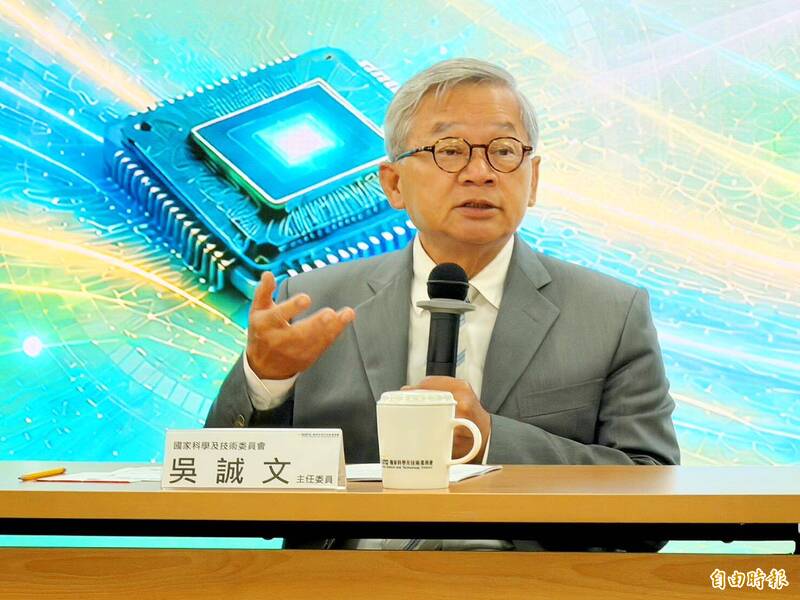
NEXT-GEN: Given its leading-edge technology, TSMC is widely assumed to be the unnamed company that is building a 1-nanometer facility in the planned science park
By Lisa Wang / Staff reporter
The National Science and Technology Council (NSTC) plans to establish a new science park in Tainan to accommodate an upcoming 1-nanometer semiconductor fabrication plant, with Taiwan Semiconductor Manufacturing Co (TSMC, 台積電) widely believed to be the operator of the next-generation chip manufacturing facility.
“Next year, we will launch a major new science park in Tainan to pave the way for 1-nanometer fabrication facilities,” NSTC Minister Wu Cheng-wen (吳誠文) told reporters on Monday on the sidelines of the IEEE Asia Solid State Circuits Conference in Taichung, adding that development would officially start next year.
The planned facility would be the nation’s 19th science park.
To facilitate the transition of local chipmakers to next-generation manufacturing technologies, the council is tasked with coordinating critical infrastructure arrangements, including land acquisition and ensuring stable water and power supplies, Wu said.
While the council did not explicitly named the operator of the prospective 1-nanometer fab, TSMC is widely believed to be the frontrunner due to its industry-leading technological capabilities.
TSMC has yet to confirm the reports.
As the world’s largest contract chipmaker, TSMC continues to aggressively advance its manufacturing road map, with its latest A14 (1.4-nanometer) process node scheduled for risk production next year and volume production by 2028.
This advanced node would primarily cater to next-generation smartphones, high-performance computing clients, and artificial intelligence applications, TSMC said.
Beyond its primary semiconductor focus, the new Tainan science park would host other pillars of Taiwan’s high-tech ecosystem, including biomedical, optoelectronics and precision machinery industries, Wu said.
The development strategy for Taiwan’s science parks remains focused on cultivating a robust, integrated ecosystem where these critical high-tech sectors can thrive alongside advanced semiconductor manufacturing, Wu said.
新聞來源:
TAIPEI TIMES