
POST-PLENUM:To shift public attention from its failing economy, China could deploy tactics to create the impression that it has jurisdiction over Taiwan, a MAC official said
By Chen Yu-fu and Shelley Shan / Staff reporters
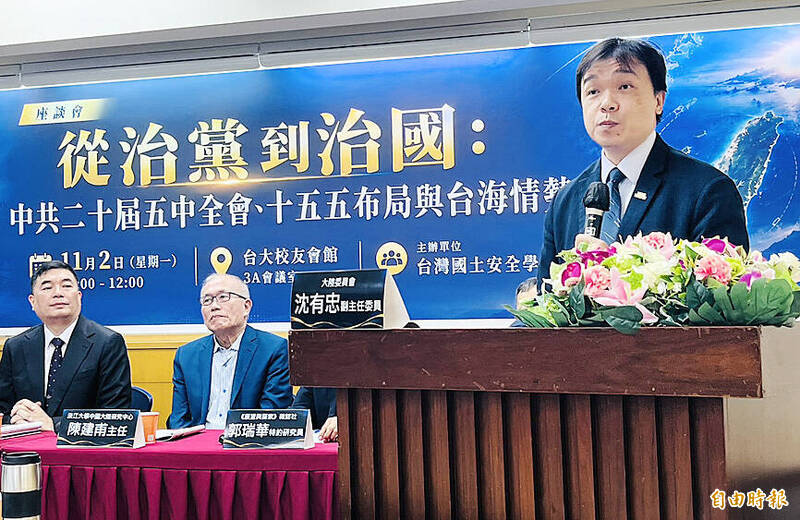
China is expected to adopt more aggressive measures against Taiwan following the Fifth Plenary Session of the Central Committee of the Chinese Communist Party (CCP) last week, Mainland Affairs Council Deputy Minister Shen Yu-chung (沈有忠) said yesterday.
The fifth plenum ended its four-day meeting last week by endorsing a core priority of Chinese President Xi Jinping (習近平) — tightening internal discipline and fighting corruption — setting the stage for his securing another term and consolidating his grip on power at next year’s 21st party congress.
“Xi is expected to further consolidate his power in the years ahead, using a campaign-style drive to crack down on corrupt Chinese officials,” Shen told a forum in Taipei. “The greater the concentration of power, the higher the risks to govern. Xi has not designated his successors either, creating greater uncertainty in Chinese politics.”
The CCP is expected to continue prioritizing national security and ideological control over the economy, which has deteriorated due to weak domestic demand, falling housing prices and massive local government debts.
Intensifying competition at home has prompted many Chinese firms to dump their goods abroad, triggering a backlash and exposing the global economy and trade to greater risks, Shen said.
As China prioritizes national security, it has stepped up economic coercion abroad, setting up trade barriers and regulating exports of rare earth and other key minerals.
“To shift public attention away from its failure to address economic problems, Beijing could implement measures to impose governance on Taiwan, even at the expense of stoking nationalism,” he said. “The CCP regime could employ multiple tactics to create a false impression that it has permanent jurisdiction over Taiwan, including engaging in gray zone harassments in waters around Taiwan and interfering in Taiwan’s democratically held elections.”
Chen Chien-fu (陳建甫), director of Tamkang University’s Institute of China Studies, said about one-quarter of the CCP Central Committee members were absent at the fifth plenum, the highest percentage compared with previous years.
China is to celebrate the 100th anniversary of the establishment of the People’s Liberation Army (PLA) next year, Chen said.
“Instead of identifying senior military officials who are being replaced, we should focus on how the new leaders adjust the military’s joint operations and command-and-control structure,” Chen said.
Any purge of high-ranking military personnel should not be interpreted as a sign of the PLA’s weakening combat capabilities, or that Beijing has changed its military plan against Taiwan, Chen said.
Hung Yao-nan (洪耀南), director of Tamkang University’s Cross-Strait Relations Research Center, said the military purge might have been completed, but Xi remains firmly in control over the military.
Kuo Jui-hua (郭瑞華), an associate research fellow at Prospect & Exploration magazine, said the widening military purge and shrinking pool of available talent are two sides of the same coin.
The officials were mostly replaced by personnel from the military’s disciplinary and political work departments, potentially leaving gaps in specialized operational and command expertise, he said.
The successive promotions of Zhang Shengmin (張升民), a PLA general and a member of the CCP’s politburo, might provide a clue to Xi’s preparation for his fourth term, Kuo said, adding that Zhang is likely to remain in office despite passing the customary retirement age.
Liu Meng-chun (劉孟俊), director of Chung-Hua Institution for Economic Research Institute’s First Research Division, said that 26.6 percent of Taiwan’s exports went to China and Hong Kong last year, down from 42.3 percent in 2021.
The US’ share of Taiwanese exports rose to 30.9 percent last year, surpassing China and Hong Kong combined for the first time in 26 years, Liu said.
However, the effects of Chinese dumping overseas could spill over to Taiwan, he said, adding that the nation needs to integrate early warning, defense and technological leadership into a comprehensive economic security strategy.
新聞來源:
TAIPEI TIMES