
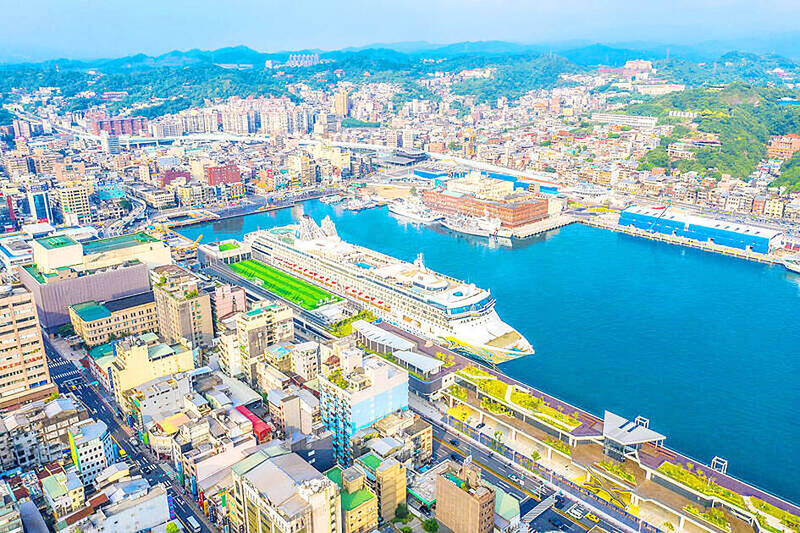
SLOW RECOVERY:With cruise ship arrivals yet to return to pre-pandemic levels, a north and south home port would optimize tourism benefits, the institute said
By Shelley Shan / Staff Reporter
Keelung and Kaohsiung could serve as Taiwan’s northern and southern cruise home ports, with Keelung focusing on routes to Japan and South Korea and Kaohsiung covering the Philippines and Vietnam, the think tank under the Ministry of Transportation and Communications said in a media briefing.
Data collected by the Institute of Transportation (IOT) showed that the number of global cruise ship passengers reached a record-high 37.20 million last year, about 25.3 percent higher than the pre-COVID-19 pandemic level.
Asia had about 3 million cruise ship passengers, about 80 percent of the pre-pandemic level, data showed.
However, the number marked a 15 percent increase compared with 2024, the institute said.
IOT deputy director-general Chen Pin-chuan (陳賓權) cited data from the Cruise Lines International Association, showing that Taiwan was the 11th largest cruise ship market from 2016 to 2019 globally, and the second largest market in Asia, preceded by China.
In 2019, Taiwan recorded 671 cruise ship arrivals and 1.06 million cruise ship passengers, Chen said. The Port of Keelung was Asia’s second largest cruise ship port, surpassing the Port of Shanghai and being preceded by the Port of Singapore, he added.
The global cruise ship market was disrupted by the COVID-19 pandemic, with cruise ship passengers in Taiwan reduced to nearly zero in 2022, Chen said.
After the government lifted COVID-19 restrictions in 2023, the number of cruise ship passengers in Taiwan rebounded to 11.57 million last year, surpassing the pre-pandemic level, he said.
However, the number of cruise ship arrivals last year has yet to return to the level in 2019, he said, adding that Taiwan ranked No. 13 in global cruise ship market and No. 4 in Asia.
“This shows the trend toward larger cruise ships, which in turn would optimize the tourism benefits that a cruise ship could bring,” Chen said.
Last year, port-of-call cruises — in which the ship stops at a Taiwanese port as part of its itinerary — accounted for 39 percent, up from 26 percent in 2024, Chen said.
Meanwhile, foreign visitors made up 58 percent of cruise travelers in 2024, with most of them coming from Japan, the US and Germany, he said.
The share of cruise ship passengers arriving through flights and boarding ships in Taiwan — also known as the fly-cruise model — rose to 11 percent by 2023, he added.
More than 64 percent of passengers choose to stay an extra night at the cruise homeport before or after their voyage, generating additional accommodation and tourism spending.
“We recommend that there be more partnerships between the Maritime and Port Bureau and Taiwan International Port Corp (TIPC) to improve port infrastructure and cultivate talents for the cruise ship industry,” Chen said.
International commercial ports in Keelung City and Kaohsiung could take on different roles as Taiwan’s northern and southern cruise homeports, with Keelung covering Japan and South Korea and Kaohsiung expanding routes to the Philippines and Vietnam, Chen said.
“With the increase of fly-cruise travelers, the bureau and the TIPC should work to facilitate the transfer between maritime and air transportation services, including enhancing the baggage handling efficiency,” he said.
TIPC previously estimated that the nation would welcome 605 cruise ships this year, with the number of cruise ship travelers exceeding 1.197 million.
新聞來源:
TAIPEI TIMES