
‘SALT AND LIGHT’:Taiwan is built ‘atop a chain of mountains that is the splendid outcome of democratic governance,’ he said in remarks opposed by China
By Chen Cheng-yu / Staff reporter, with agencies
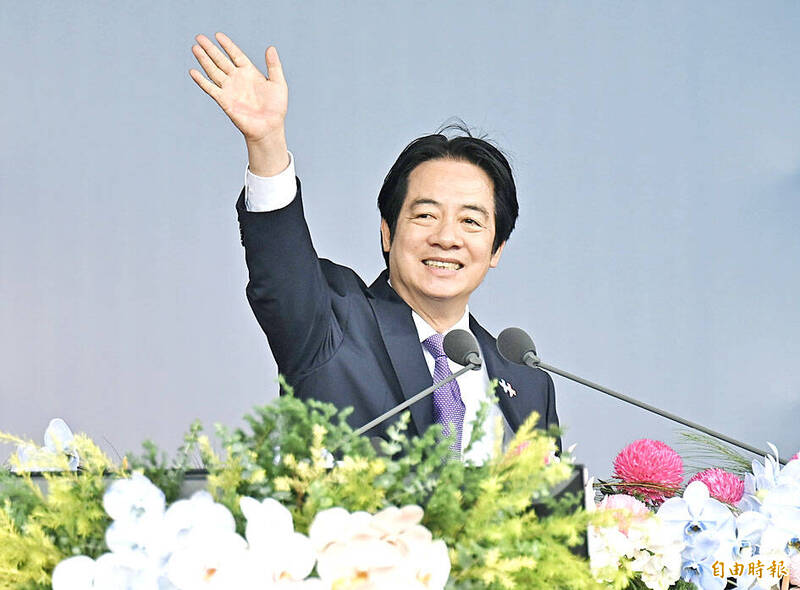
President William Lai (賴清德) yesterday urged Taiwan to become a “city upon a hill” amid authoritarian expansion and global upheaval, adding that Taiwan cherishes peace, but will not give up its freedom.
“In this era marked by war, authoritarian expansion and a rapidly shifting global order, what kind of nation should Taiwan strive to be? My answer is this: We must become a ‘city upon a hill,’ built with courage and confidence,” Lai said in a Double Ten National Day speech titled “Taiwan’s Future: A City upon a Hill, the Salt and Light of the World” at a ceremony in front of the Presidential Office Building in Taipei.
“This is not to sing our own praises, but rather to declare our aspirations for the nation’s future,” he said. “It is also a responsibility Taiwan stands ready to shoulder.”
“City upon a hill” and “salt and light” are elements from Jesus’ Sermon on the Mount.
“This city upon a hill is built atop a chain of guardian mountains that is the splendid outcome of democratic governance which grants us a solid basis for peace of mind,” Lai said, adding that it must stand on a firm foundation and that “the well-being of our people is the very foundation of Taiwan.”
Lai pledged that his administration would pursue pragmatic governance by raising wages, cutting taxes, expanding welfare and easing financial burdens, so everyone can enjoy greater economic security and a better quality of life.
Facing China’s far larger military, which is adding advanced new weapons such as stealth fighter jets, aircraft carriers and a huge array of missiles, Taiwan is ramping up defense spending and modernizing its armed forces, he said.
The government’s increased investment in defense aimed to deter war, not provoke it, he added.
“And we are strengthening our self-defense not to abandon dialogue, but to ensure that dialogue can take place on the basis of parity and dignity,” he told the crowd at the event, during which he watched military displays and dance performances.
Peace cannot rely solely on “wishes,” Lai said. “Taiwan cherishes peace, but we will not give up our freedom. We are open to exchanges, but will not accept subordination.”
“There must be respect for the right of the people of Taiwan to exist,” he said.
Lai urged democracies in the Indo-Pacific region to join forces to retain the “status quo” of peace and stability in the region.
China has exerted pressure in an attempt to change the “status quo” across the Taiwan Strait, Lai said. The nation’s “resolve” is not just about its own survival in the face of “authoritarian expansion,” it is also about whether the international community still believes that force cannot override rules.
The US welcomes Lai’s commitment to maintaining peace and stability across the Taiwan Strait, a senior White House official said, adding, in reference to China, that “a routine speech is no justification for aggressive or coercive actions.”
China’s Taiwan Affairs Office later yesterday criticized Lai’s speech, saying that it “disregards facts, distorts the truth, misleads the public and reveals ulterior motives.”
In his speech, Lai “stubbornly clung to ‘Taiwan independence’ separatist thinking” and exaggerated the “threat from the mainland,” the office said.
“There is only one China in the world and Taiwan is part of China — this is the true status quo in the Taiwan Strait,” it said, adding that Taiwan’s future “can and must be decided jointly by all the Chinese people, including our compatriots in Taiwan.”
In 2024, shortly after Lai’s first National Day speech as president, China held war games around Taiwan, but did not do so last year.
Its most recent war games near Taiwan were in late December last year, following news of Washington agreeing to a US$11 billion arms deal for Taipei, the largest ever.
US President Donald Trump has yet to approve a second package, worth US$14 billion.
新聞來源:
TAIPEI TIMES